26 Nov 2026
Beyond Classical Compute: How Accelerated Simulation and Quantum Frameworks Are Reshaping Scientific Data Science
By Diwakar Chandra Gour
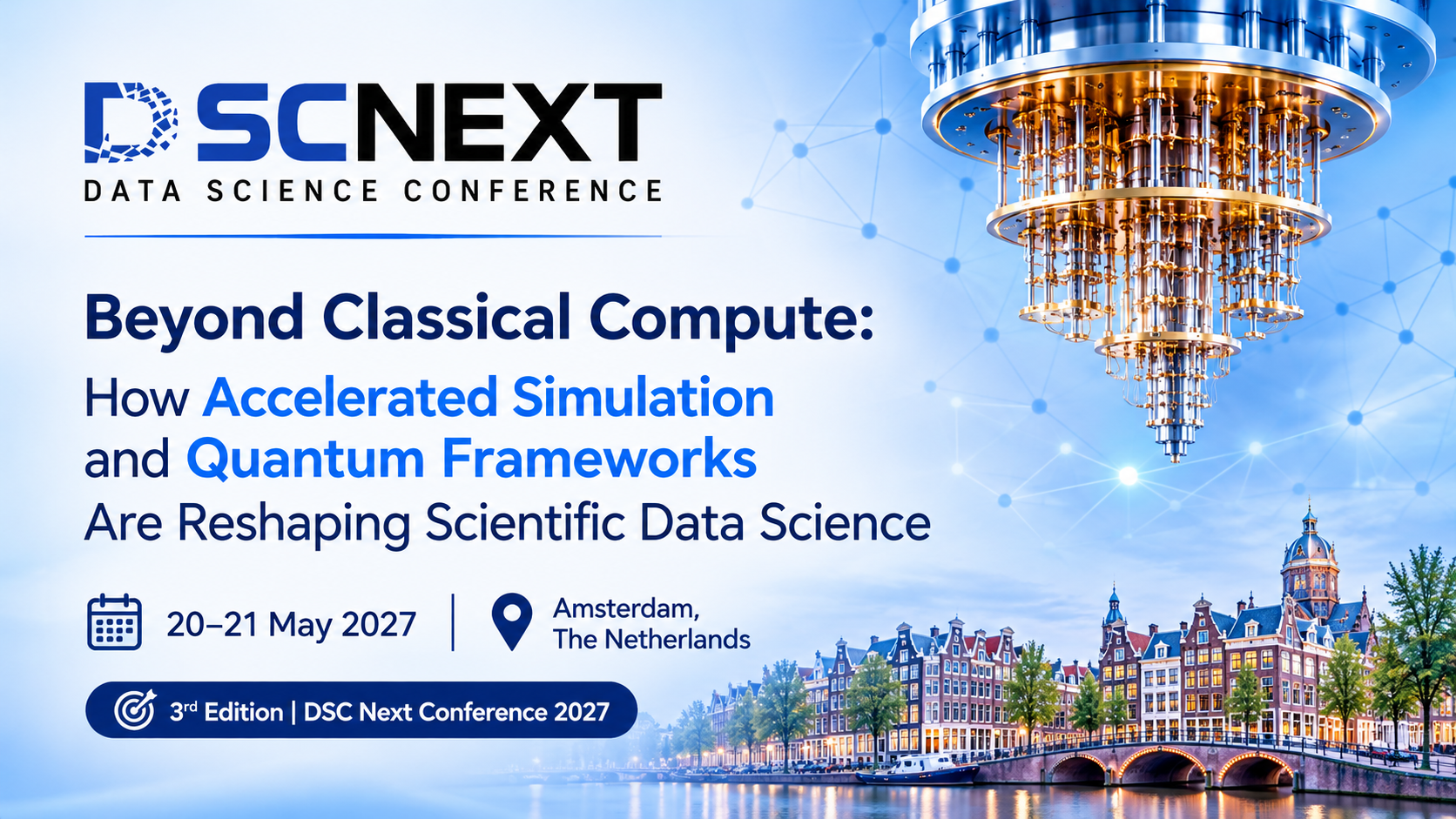
Beyond Classical Compute: How Accelerated Simulation and Quantum Frameworks Are Reshaping Scientific Data Science
Why Classical Compute Alone Hits a Wall in Scientific Workloads
Exponential State Spaces: Modeling molecular interactions, fusion materials, fluid dynamics, or multi-variable supply and energy grids quickly overwhelms brute-force classical search.
Slow Hypothesis-to-Simulation Cycles: When a single high-fidelity simulation takes days or weeks, iterative experimentation stalls—limiting how many candidate designs or scenarios researchers can test.
Tighter Coupling Between AI and Physics: Modern scientific workflows increasingly use AI agents and surrogate models to propose hypotheses, invoke physics or numerical solvers, evaluate results, and refine the next step automatically.
Two Pillars Reshaping Scientific Data Science
1. Accelerated HPC & Simulation-Driven AI
2. Quantum-Inspired Methods & Hybrid Quantum Frameworks
Quantum-Inspired Optimization & Tensor Methods: Techniques inspired by quantum mechanics—such as tensor networks, simulated/quantum-inspired annealing, and variational search—are already used on classical and GPU clusters to tackle tough combinatorial optimization, portfolio allocation, routing, and feature-selection problems.
Accessible Hybrid Toolkits (Qiskit & Cirq): Frameworks like Qiskit and Cirq allow data scientists and researchers to prototype variational quantum circuits, test hybrid quantum-classical loops, and benchmark quantum-centric supercomputing workflows alongside classical ML pipelines.
Quantum-Centric Supercomputing: Across materials science, chemistry, and error-correction research, organizations are pairing classical GPUs/HPC with quantum processors so each compute paradigm handles the sub-problem best suited to its strengths.
Practical Takeaways for Data Scientists and Research Teams
Master Hybrid Abstractions Early: Learn how classical ML models, differentiable physics/numerical solvers, and quantum circuit simulators (via Qiskit, Cirq, or GPU-accelerated simulators) pass parameters and gradients back and forth.
Focus on Problem Structure, Not Hype: Quantum and quantum-inspired approaches shine on specific structured optimization, simulation, and Hamiltonian/graph problems—not every business analytics query. Benchmark rigorously against strong classical baselines.
Design for Reproducibility and Scale: Scientific data pipelines live or die by numerical stability, precision awareness, and reproducible experimentation across CPUs, GPUs, and hybrid backends.
Join the Conversation at DSC Next 2027 Amsterdam
Dates: May 20–21, 2027
Location: Park Plaza Amsterdam Airport, Amsterdam, Netherlands
Official Website:
https://dscnextconference.com/
What to Expect: Keynote sessions, technical deep-dives across AI, scientific computing, and data engineering, multidisciplinary discussions, and international networking.