26 Nov 2026
Introduction: Understanding the Technologies Behind Modern AI
By Diwakar Chandra Gour
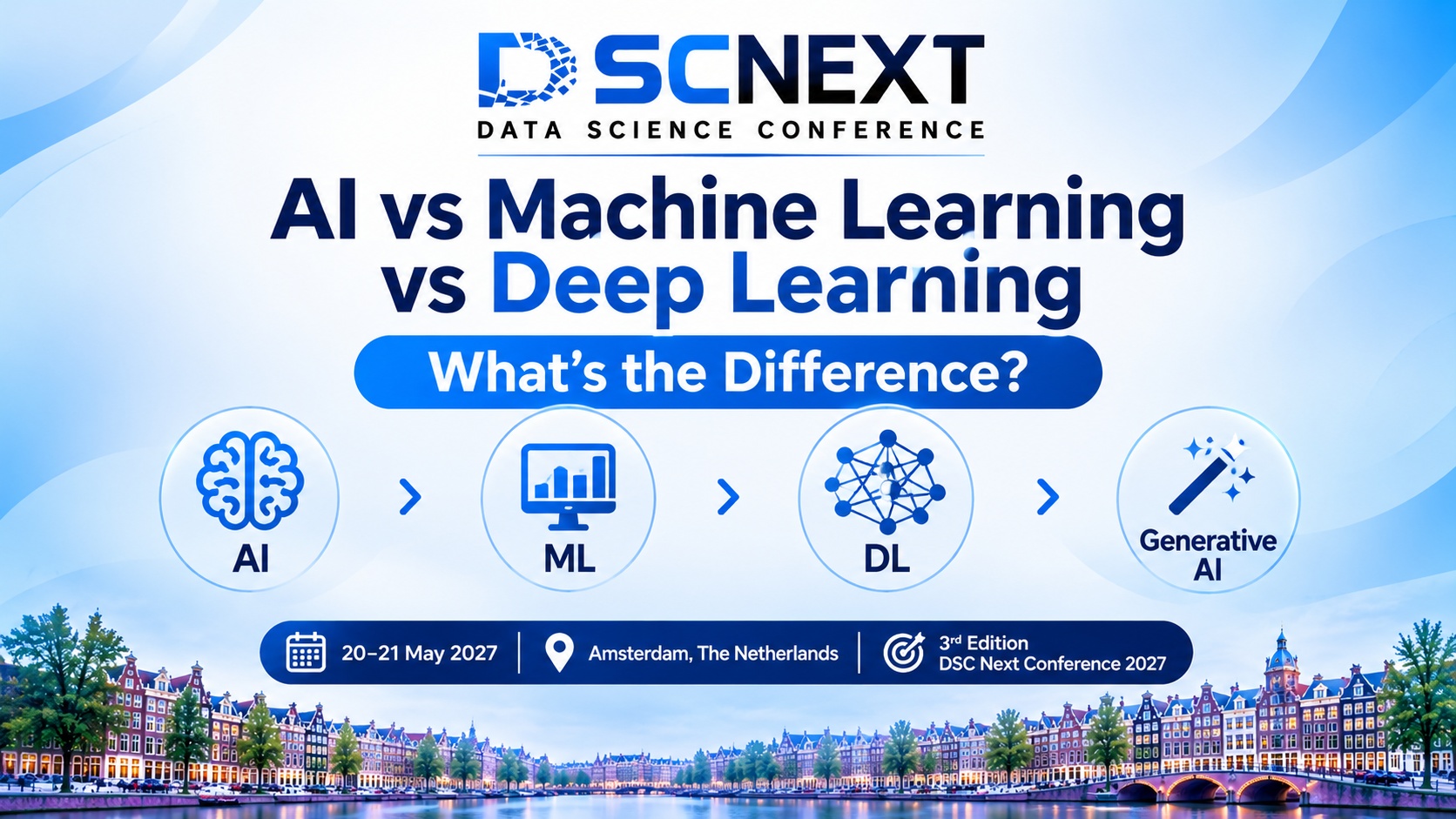
AI vs Machine Learning vs Deep Learning: What's the Difference?
Meta Title: AI vs Machine Learning vs Deep Learning: Key Differences Explained
Meta Description: Understand AI vs machine learning vs deep learning and generative AI with simple examples, practical applications, key differences, and a beginner's learning guide.
Suggested URL Slug: ai-vs-machine-learning-vs-deep-learning
Primary Keywords: AI vs machine learning, machine learning vs deep learning, difference between AI and ML, types of artificial intelligence, generative AI explained.
Suggested Category: Artificial Intelligence / Data Science
Introduction: Understanding the Technologies Behind Modern AI
Artificial Intelligence (AI), Machine Learning (ML), Deep Learning (DL), and Generative AI are some of the most discussed technologies in today's digital world. From voice assistants and online recommendations to fraud detection and AI-generated content, these technologies are changing how people interact with machines.
However, many people use these terms interchangeably without understanding how they are connected or what makes them different.
Are AI and Machine Learning the same thing? Is Deep Learning a more advanced version of Machine Learning? And where does Generative AI fit into the picture?
Although these technologies are closely related, each has a different purpose and approach.
In simple terms, Artificial Intelligence is the broader concept of making machines perform tasks that typically require human intelligence. Machine Learning is a way to achieve AI by allowing systems to learn from data. Deep Learning is a specialized type of Machine Learning that uses multiple layers of artificial neural networks. Generative AI focuses on creating new content, such as text, images, audio, and video.
Understanding the difference between AI vs Machine Learning vs Deep Learning can help students, professionals, and business owners understand how modern intelligent systems work and where these technologies can be applied.
Let's explore each concept with practical examples.
1. What Is Artificial Intelligence (AI)?
Artificial Intelligence refers to the ability of computer systems to perform tasks that generally require human intelligence.
These tasks may include understanding language, recognizing images, solving problems, making decisions, and identifying patterns.
The main goal of AI is to develop systems that can perform intelligent tasks and assist humans in different activities.
For example, when you ask a voice assistant to set an alarm, the system interprets your request and performs the action. When an online shopping platform recommends products based on your interests, AI technologies may help determine which products are relevant.
Simple Examples of Artificial Intelligence
Voice Assistants: Systems such as Siri and Google Assistant understand voice commands and respond to requests.
Navigation Applications: Intelligent systems help recommend routes and estimate travel times.
Customer Support: AI-powered assistants answer common customer questions.
Facial Recognition: Computer systems identify or verify faces in images.
Recommendation Systems: Streaming and shopping platforms suggest content or products.
Types of Artificial Intelligence
AI is commonly discussed through two different classifications.
Based on capabilities:
Narrow AI (ANI): Designed to perform specific tasks, such as voice recognition, image classification, or language translation. Most AI systems used today belong to this category.
Artificial General Intelligence (AGI): A theoretical form of AI that could perform a broad range of intellectual tasks at a human-like level. It has not been achieved.
Artificial Superintelligence (ASI): A hypothetical form of intelligence that would surpass human intelligence across many areas.
Based on functionality:
Reactive Machines: Respond to specific situations without retaining memories of previous experiences.
Limited Memory: Use stored or recent information to make decisions.
Theory of Mind: A proposed AI capability involving the understanding of human emotions, beliefs, and intentions.
Self-Aware AI: A hypothetical system with consciousness and awareness of its own existence.
These classifications are useful for understanding AI concepts, but they do not represent a list of technologies that are all currently available.
2. What Is Machine Learning (ML)?
Machine Learning is a branch of Artificial Intelligence that allows computer systems to learn patterns from data and improve their performance without requiring developers to manually program every individual rule.
Instead of giving a computer instructions for every possible situation, developers provide data and a learning method. The system identifies patterns and uses what it has learned to make predictions or decisions.
A Simple Example of Machine Learning
Imagine an email application that identifies spam messages.
Initially, the system is trained using examples of spam and legitimate emails. It learns patterns such as suspicious links, unusual wording, and repeated promotional messages.
When a new email arrives, the model analyzes its characteristics and estimates whether it is spam.
As the system is updated with suitable training data, it can improve its ability to recognize unwanted messages.
How Does Machine Learning Work?
A typical Machine Learning process involves four main steps:
Data Collection: Gather relevant information, such as customer records, images, transactions, or emails.
Model Training: Use an algorithm to identify patterns in the collected data.
Testing: Evaluate the model using data it has not previously seen.
Prediction: Use the trained model to make predictions on new information.
Main Types of Machine Learning
Supervised Learning: The model learns from examples that already have correct answers or labels. For example, predicting house prices using historical property information.
Unsupervised Learning: The model identifies patterns or groups in data without predefined labels. For example, grouping customers according to purchasing behavior.
Reinforcement Learning: The system learns through interactions with an environment, receiving rewards or penalties based on its actions. For example, training a system to play a game.
Machine Learning is widely used in recommendation systems, fraud detection, customer analytics, forecasting, and predictive maintenance.
3. What Is Deep Learning (DL)?
Deep Learning is a specialized branch of Machine Learning that uses artificial neural networks with multiple layers to learn complex patterns from large amounts of data.
These networks are loosely inspired by the way interconnected neurons work in the human brain, although artificial neural networks are mathematical computing systems and do not function like biological brains.
The word "deep" refers to the multiple processing layers within these networks.
A Simple Example of Deep Learning
Imagine you want a computer to recognize different animals in photographs.
A traditional approach may require developers to identify specific characteristics, such as shape, color, or size.
A Deep Learning model can learn useful visual patterns from many labeled images.
During training, different network layers learn different representations. Earlier layers may identify simple visual features, while later layers combine those features to recognize more complex objects.
This allows the system to identify animals in new photographs.
How Does Deep Learning Work?
Deep Learning models generally use three main types of layers:
Input Layer: Receives information such as images, text, or numerical data.
Hidden Layers: Process the information and learn increasingly complex patterns.
Output Layer: Produces the final result, such as an image classification or prediction.
Deep Learning is especially useful for tasks involving complex information, including speech recognition, computer vision, language understanding, and medical image analysis.
However, it often requires substantial computing resources, large datasets, and careful training.
4. What Is Generative AI?
Generative AI is a category of AI that creates new content based on patterns learned from existing data.
Unlike traditional systems that mainly classify information or make predictions, Generative AI can produce original outputs such as text, images, music, audio, video, and computer code.
Simple Examples of Generative AI
Text Generation: ChatGPT can help write articles, summarize documents, and answer questions.
Image Generation: Image-generation systems can create illustrations and designs from written prompts.
Code Generation: AI coding assistants can suggest code and explain programming concepts.
Audio Generation: AI tools can generate speech and other audio content.
Video Generation: Generative systems can create or transform video content.
How Does Generative AI Work?
Generative AI models learn patterns and relationships from training data.
For example, a large language model learns statistical relationships between words and other tokens. When a user enters a prompt, the model generates a response by predicting suitable subsequent tokens.
Many modern Generative AI systems use Deep Learning architectures, including Transformer-based neural networks.
Generative AI is useful for content creation, research assistance, customer support, software development, and creative workflows.
However, generated content can contain inaccurate information, so important outputs should always be reviewed.
5. How Are AI, Machine Learning, Deep Learning, and Generative AI Related?
The easiest way to understand their relationship is to think of them as connected concepts rather than four completely separate technologies.
Artificial Intelligence is the broadest field. Machine Learning is one approach within AI. Deep Learning is a specialized approach within Machine Learning. Generative AI is a category of systems focused on generating new content, and many modern Generative AI models use Deep Learning.
Think of the relationship like this:
Artificial Intelligence → Machine Learning → Deep Learning → Many Modern Generative AI Systems
This is a simplified representation rather than a strict classification of every AI technology. Generative AI is not limited to Deep Learning in principle, and not every Deep Learning model is generative.
For example:
AI can include rule-based systems that do not learn from data.
Machine Learning can predict whether a transaction is fraudulent.
Deep Learning can recognize objects in photographs.
Generative AI can create an image or write a product description.
Understanding these relationships makes it easier to see why the terms are connected but not interchangeable.
6. Real-World Applications Across Different Industries
AI, Machine Learning, Deep Learning, and Generative AI are already being used across multiple industries.
Healthcare
Healthcare organizations use AI technologies to support medical research, patient management, and clinical workflows.
Examples include:
Analyzing medical images to help identify potential abnormalities.
Predicting patient risks using historical health information.
Supporting drug discovery and medical research.
Generating summaries of medical documentation.
These systems support healthcare professionals but do not replace qualified medical judgment.
Finance and Banking
Financial institutions use AI and Machine Learning to improve security, analyze financial information, and support customer services.
Examples include:
Detecting suspicious financial transactions.
Identifying unusual spending patterns.
Assessing financial risks.
Automating customer support.
Analyzing financial documents.
Retail and E-Commerce
Online shopping platforms use intelligent systems to improve the shopping experience.
Examples include:
Recommending products based on customer interests.
Forecasting product demand.
Managing inventory.
Analyzing customer purchasing patterns.
Generating product descriptions and marketing content.
Cybersecurity
AI and Machine Learning help security teams identify unusual activities and potential threats.
Applications include:
Detecting suspicious network traffic.
Identifying unusual login behavior.
Recognizing potentially malicious files.
Prioritizing security alerts.
Supporting threat analysis.
AI can also be used by attackers, so cybersecurity professionals must understand both its benefits and risks.
Manufacturing
Manufacturing companies use AI technologies to improve production processes and reduce operational problems.
Examples include:
Predicting equipment failures through sensor data.
Identifying defects using computer vision.
Optimizing production schedules.
Monitoring product quality.
Supporting industrial robots.
These applications can improve efficiency, but their success depends on reliable data, suitable infrastructure, and human supervision.
7. AI vs Machine Learning vs Deep Learning vs Generative AI: Comparison Table
The following table summarizes the major differences.
| Feature | Artificial Intelligence | Machine Learning | Deep Learning | Generative AI |
|---|---|---|---|---|
| Meaning | Broad field of intelligent systems | Learning from data | Multi-layer neural network learning | Creating new content |
| Main goal | Perform intelligent tasks | Learn patterns and predict | Learn complex patterns | Generate new outputs |
| Methods | Rules, search, ML, and others | Statistical and learning algorithms | Neural networks with multiple layers | Generative models and neural networks |
| Data needs | Depends on approach | Usually requires training data | Often needs large datasets | Often trained on large datasets |
| Applications | Robotics and assistants | Fraud detection and forecasting | Image and speech recognition | Text, image, audio, and video generation |
| Example | Voice assistant | Spam detection model | Facial recognition model | ChatGPT or an image generator |
The key difference is their scope and purpose. AI is the broader field, ML is a data-driven approach, DL is a neural-network-based approach, and Generative AI focuses on creating content.
8. Which Technology Should Beginners Learn First?
If you are new to AI, deciding where to begin can feel confusing. The best starting point depends on your interests and career goals.
However, understanding the fundamentals of Artificial Intelligence before moving into specialized areas is a sensible approach.
Step 1: Understand AI Fundamentals
Start by learning what AI is, how intelligent systems work, and where they are used.
Understand basic concepts such as automation, data, algorithms, and AI models.
Step 2: Learn Basic Machine Learning Concepts
Explore how computers learn from examples.
Begin with concepts such as supervised learning, unsupervised learning, classification, prediction, and training data.
You do not need advanced mathematics at the beginning.
Step 3: Explore Deep Learning
Once you understand Machine Learning, explore neural networks and how they process information.
Learn about image recognition, speech recognition, and natural language processing.
Step 4: Experiment With Generative AI
Try beginner-friendly tools such as ChatGPT, Google Gemini, and image-generation applications.
Experiment with writing prompts, summarizing information, generating ideas, and understanding how different models respond.
Step 5: Build Small Practical Projects
Practical experience helps turn theoretical knowledge into useful skills.
Some beginner project ideas include:
Creating a simple spam email classifier.
Building a product recommendation prototype.
Creating a basic image classification model.
Developing an AI-powered FAQ assistant.
Experimenting with a Generative AI content assistant.
You can explore beginner learning resources such as Google Machine Learning Crash Course, Microsoft's AI learning resources, and the DeepLearning.AI introductory courses.
The most important thing is to learn step by step and build practical experience rather than trying to understand every advanced concept immediately.
Conclusion: Understanding the Technologies Shaping the Future
Artificial Intelligence, Machine Learning, Deep Learning, and Generative AI are closely connected technologies, but each serves a different purpose.
AI is the broader concept of building intelligent systems. Machine Learning allows systems to learn from data. Deep Learning uses multi-layer neural networks to understand complex patterns. Generative AI takes these capabilities further by creating new content such as text, images, audio, and video.
Understanding the difference between AI and ML, as well as Machine Learning vs Deep Learning, provides a strong foundation for anyone interested in technology and data science.
As these technologies continue to develop, their applications across healthcare, finance, retail, cybersecurity, and manufacturing will create new opportunities for businesses and professionals.
To explore these developments further, join the conversations around emerging technologies, data science, and artificial intelligence at DSC Next Conference 2027 – 3rd Edition, taking place on 20–21 May 2027 in Amsterdam, The Netherlands.
It is an opportunity to engage with the ideas, innovations, and industry perspectives shaping the future of data science and AI.
The best way to understand the future of AI is to start learning how it works today.