19 Nov 2026
Microsoft’s New Specialized AI Models for Coding and Cybersecurity: Reshaping Enterprise AI Economics.
By Diwakar Chandra Gour
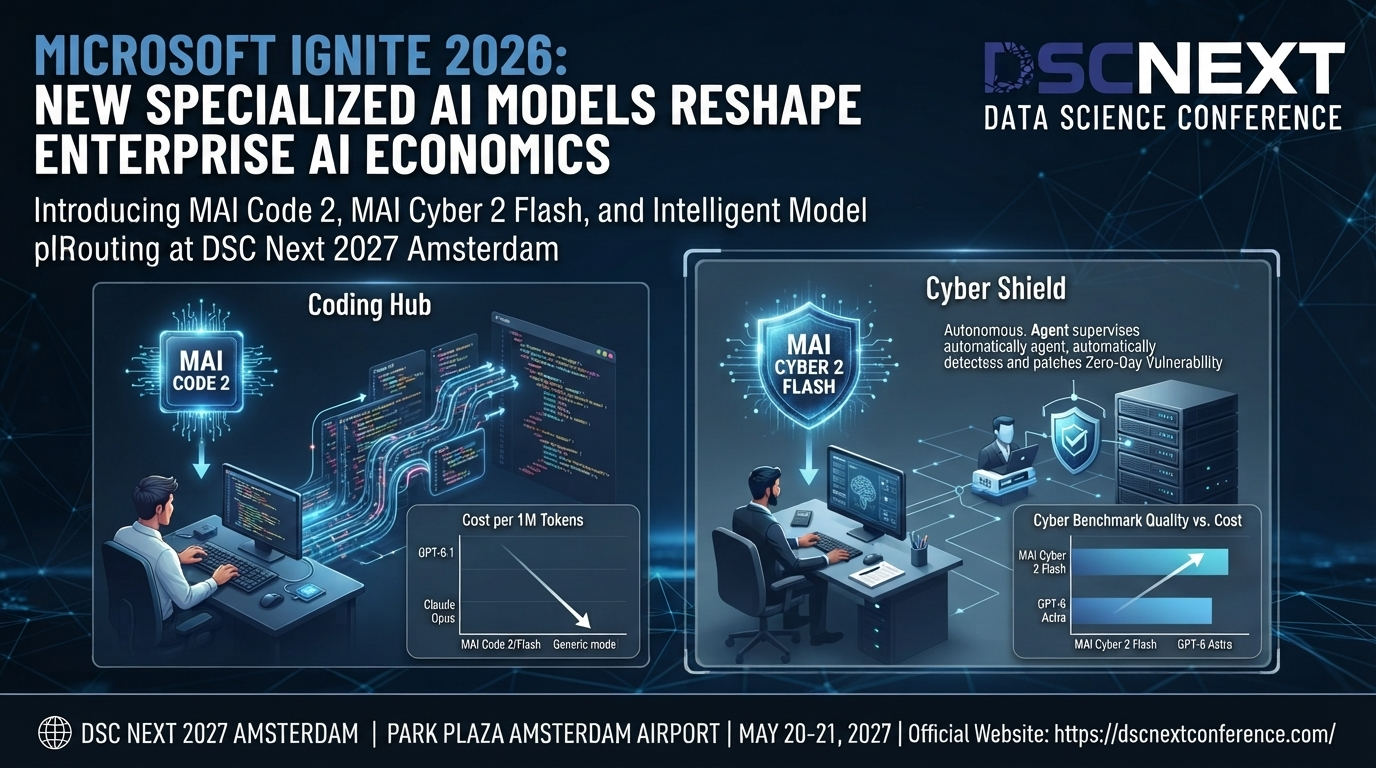
Microsoft’s New Specialized AI Models for Coding and Cybersecurity: Reshaping Enterprise AI Economics.
1. MAI Code 2 & Code 2 Flash: Frontier Coding at a Fraction of the Cost
MAI Code 2: Built for demanding, multi-step agentic coding and complex software architecture, Microsoft reports that MAI Code 2 achieves 98% of the coding quality of OpenAI’s GPT-6.1 Sol at roughly 40% of the price, and 96% of Anthropic’s Claude Opus 5.5 performance at just 5% of the cost. Priced at $1 per million input tokens and $5 per million output tokens, it is also tuned for frontend engineering, dashboards, and data visualizations—where developers preferred its output over GPT-6 Sol 64% of the time in blind side-by-side evaluations.
MAI Code 2 Flash: Engineered for high-volume, everyday developer workflows, Code 2 Flash brings low-latency autocomplete, refactoring, and rapid test generation directly into GitHub Copilot and Microsoft Foundry.
2. MAI Cyber 2 Flash: Agentic Defence at Codebase Scale
Benchmark & Cost Breakthrough: On the CyberGym-E2E benchmark, MAI Cyber 2 Flash outperforms OpenAI’s GPT-6 Astra in quality while operating at less than 2% of the cost per task. Furthermore, its output token pricing is 86% lower than its predecessor (MAI Cyber 1.1 Flash).
Controlled Rollout & Alignment Safeguards: Recognizing the dual-use risks of offensive vulnerability-hunting capabilities, Microsoft is rolling out MAI Cyber 2 Flash initially to vetted security partners and eligible customers (including Codename MDASH users starting in mid-December 2026) under strict alignment and safety guardrails.
3. Beyond Code and Cyber: Decision Routing, Licensed Weights & Maia 200
Decision 1.1 & Intelligent Model Routing: Built to power fast classification, verification, and workload routing in Microsoft Foundry, Decision 1.1 operates 50x faster and 79x cheaper than GPT-6.1 Sol. Instead of sending every prompt to an expensive reasoning model, enterprises can automatically route tasks to the most economical specialized model.
MAI Licensed Weights: Addressing corporate concerns around intellectual property and black-box dependencies, Microsoft introduced MAI Licensed Weights—allowing enterprises to customize frontier MAI models on proprietary data and run them securely inside their own dedicated Azure environments under full access control.
Custom Silicon Efficiency (Maia 200): Powering these workloads is Microsoft’s second-generation AI accelerator, Maia 200, now in production and delivering 1.7x more tokens per watt to keep energy and cloud compute costs sustainable.
What This Means for Data Science & AI Leaders
Specialization Beats Generalization: Domain-tuned models for coding, cyber defense, and routing consistently outperform monolithic models on price-to-performance.
AI Economics Is Now a Core Architectural Metric: Token cost per completed task—not just raw benchmark score—is dictating which models survive in production.
Sovereignty and Alignment Are Non-Negotiable: Enterprises demand licensed model control, private deployment environments, and verifiable safety boundaries before scaling autonomous agents.
Join the Conversation at DSC Next 2027 Amsterdam
Dates: May 20–21, 2027
Location: Park Plaza Amsterdam Airport, Amsterdam, Netherlands
Official Website:
https://dscnextconference.com/ What to Expect: High-impact keynotes, technical deep dives into agentic workflows, AI cybersecurity, and enterprise AI economics, multidisciplinary panels, and premier global networking.