18 Nov 2026
The "Build vs. Buy" Disruption: How Agentic Coding Is Reshaping Enterprise Software and Data Economics.
By Diwakar Chandra Gour
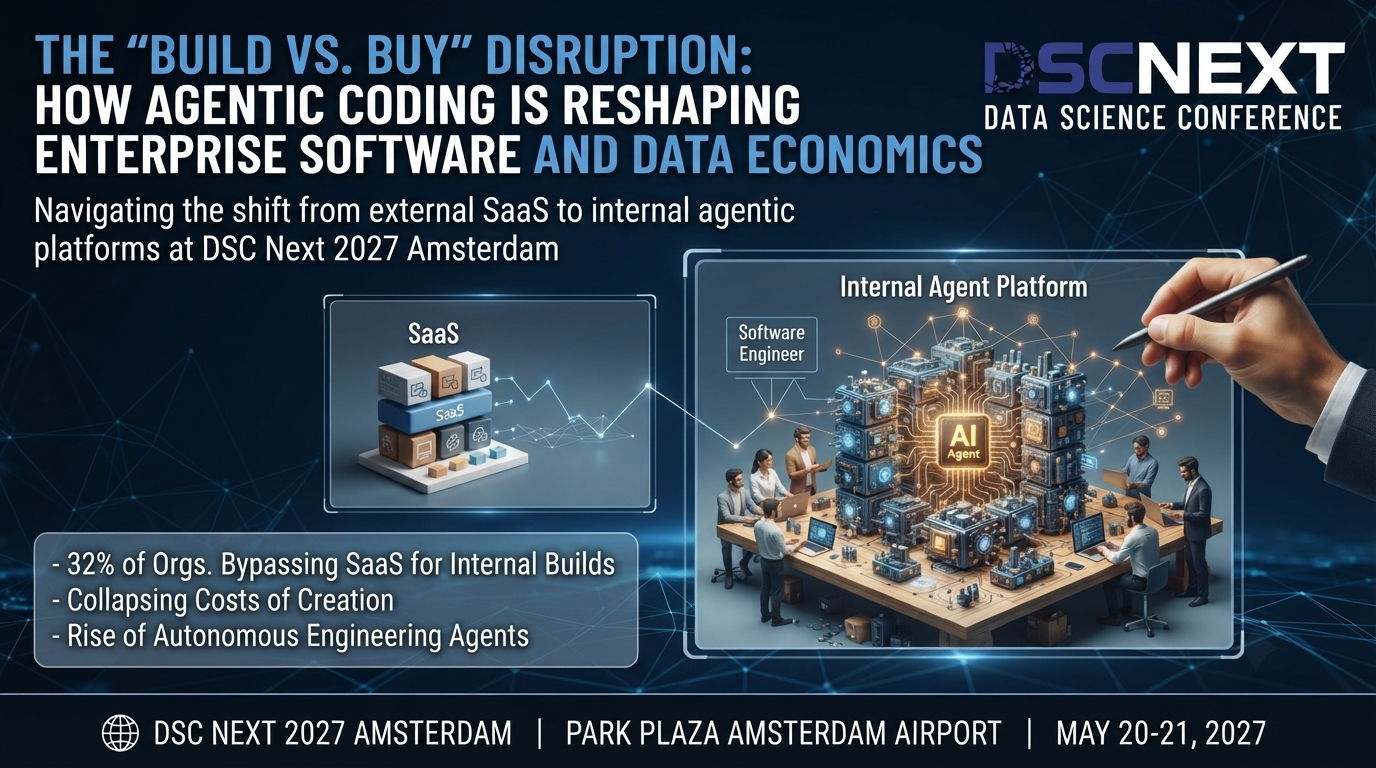
The "Build vs. Buy" Disruption: How Agentic Coding Is Reshaping Enterprise Software and Data Economics.
For more than a decade, the default enterprise technology playbook was straightforward: buy first, customize later. Whenever an organization needed an analytics dashboard, an internal approval workflow, or a specialized line-of-business tool, the reflex was to sign a recurring Software-as-a-Service (SaaS) contract rather than endure the slow, expensive timeline of custom software development.
Today, that long-standing equilibrium is breaking down.
According to McKinsey’s State of AI global survey, 32% of organizations have already decided against purchasing one or more software products or features because they could build them internally using agentic coding tools. In the technology sector, that figure climbs to 41%, followed closely by healthcare (39%) and financial services (36%). Among AI high performers—organizations attributing 5% or more of their EBIT directly to AI—nearly half are bypassing external software purchases in favor of internal builds.
Driven by autonomous software engineering agents capable of planning architectures, writing full-stack code, generating test suites, and integrating internal APIs, the "Build vs. Buy" equation has fundamentally inverted.
Why the Economics of Software Have Inverted
Two powerful market forces are converging to accelerate this shift across boardrooms, CFO offices, and engineering teams:
The Collapsing Cost of Creation: Agentic coding tools have compressed what used to require a multi-month engineering sprint into days or hours. Instead of writing boilerplate code from scratch, data scientists and software engineers now act as system architects—defining data schemas, security boundaries, and business logic while autonomous coding agents generate, test, and document the underlying application.
Escalating SaaS Inflation and Seat-Based Friction: While the cost of producing custom software has plummeted, the cost of renting generic software has steadily climbed. Per-seat licensing models, rigid vendor roadmaps, and expensive add-on modules force enterprises to pay escalating recurring fees for tools that only partially match their proprietary workflows.
When an organization already owns its underlying data and infrastructure, building a bespoke internal analytics portal, quoting engine, or workflow orchestrator around its exact operational logic is no longer an extravagant luxury—it is a rational financial decision.
What Enterprises Are Building—and What They Still Buy
The rise of agentic coding does not mean enterprises are abandoning every external vendor. Instead, mature data and engineering leaders are drawing a sharp strategic boundary between commodity infrastructure and differentiating workflows:
What Organizations Are Building In-House: Internal analytics dashboards, custom ETL connectors, automated data-quality monitors, lightweight workflow apps, and specialized internal copilots tailored directly to proprietary data models.
What Organizations Still Buy: Mission-critical systems of record—such as core accounting ledgers, payroll engines, identity management, and regulated compliance platforms—where vendor uptime, global regulatory certifications, and edge-case liability remain essential.
The Hidden Trap: Generation Is Cheap, Ownership Is Not
While spinning up a working prototype with coding agents is fast, experienced engineering leaders warn against confusing code generation with long-term software ownership.
An internally built tool still requires ongoing maintenance, security patching, dependency updates, and clear human accountability. Organizations seeing the highest financial returns from agentic coding are not simply cutting vendor bills—they are pairing internal builds with strong engineering governance, automated evaluation pipelines, and redesigned business workflows that turn proprietary data into a competitive advantage.
Join the Conversation at DSC Next 2027 Amsterdam
As autonomous coding agents transform how enterprises architect software, manage data pipelines, and measure technology ROI, navigating the new "Build vs. Buy" landscape has become a top priority for data leaders, founders, and technology executives alike.
If you want to explore the architectures, governance frameworks, and real-world economics shaping the next generation of enterprise AI, join us at DSC Next 2027 (3rd Edition)!
Dates: May 20–21, 2027
Location: Park Plaza Amsterdam Airport, Amsterdam, Netherlands
Official Website:
https://dscnextconference.com/ What to Expect: High-impact keynotes, technical deep-dives into agentic engineering and enterprise AI ROI, multidisciplinary panel discussions, and premier networking with global data science pioneers.
Whether you are scaling internal AI platforms or rethinking your enterprise technology stack, DSC Next 2027 is the definitive forum to turn emerging disruption into sustainable growth.
Explore the conference agenda and secure your pass today at