30 Oct 2026 · Data Science, Programming, Machine Learning
Top 10 Programming Languages for Data Science
By Diwakar Chandra Gour
Introduction
Choosing among the top programming languages for data science is one of the first decisions a student, analyst or engineering team has to make. The choice affects how quickly you can explore data, how easily a model moves into production, and how well your work fits an organization's existing systems.
This guide covers ten languages widely used in data science, machine learning, artificial intelligence and analytics. For each one it explains what the language does well, where it is used, and what to watch for. It also sets out the criteria behind the list. Rankings like this depend on context, so treat the order as a starting point rather than a verdict.
Why Programming Languages Matter in Data Science
Data science combines statistics, computer science and domain knowledge. A programming language is the tool that connects them. It is how practitioners collect and clean data, run statistical tests, train machine learning models, build visualizations and deploy results.
The right language can shorten experimentation, make analyses reproducible and give you access to a mature ecosystem of libraries. A poor fit can slow a project through missing tools, performance limits or difficulty hiring and training people.
Most professionals use more than one language. A typical workflow might use SQL to pull data, Python to model it, and a compiled language to serve predictions at scale. Knowing the strengths of each helps you assemble a practical toolkit.
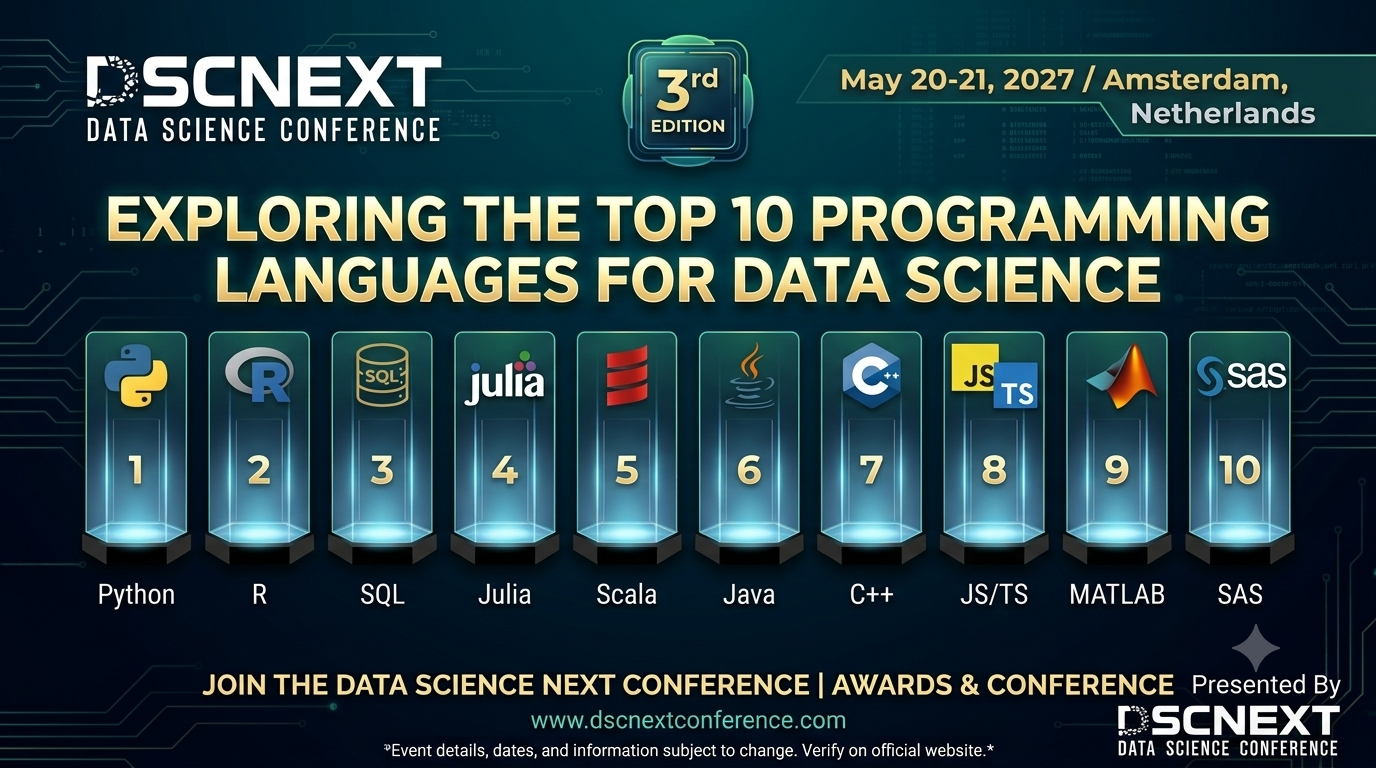
The Top 10 Programming Languages for Data Science
- Python
- R
- SQL
- Julia
- Scala
- Java
- C++
- JavaScript and TypeScript
- MATLAB
- SAS
Quick Comparison
| Language | Primary strength | Typical use | Learning curve |
|---|---|---|---|
| Python | General-purpose, vast ML ecosystem | Machine learning, analytics, automation | Gentle |
| R | Statistical analysis and visualization | Research, statistics, reporting | Moderate |
| SQL | Querying relational data | Data extraction, analytics engineering | Gentle |
| Julia | High-performance numerical computing | Scientific computing, simulation | Moderate |
| Scala | Big data processing on the JVM | Apache Spark pipelines | Steep |
| Java | Enterprise-scale systems | Data infrastructure, production services | Moderate |
| C++ | Speed and low-level control | ML runtimes, performance-critical code | Steep |
| JavaScript/TypeScript | Web delivery and interactivity | Dashboards, in-browser ML | Moderate |
| MATLAB | Numerical and engineering computing | Signal processing, control, prototyping | Moderate |
| SAS | Governed enterprise analytics | Healthcare, finance, regulated sectors | Moderate |
The learning-curve column is a general characterization and will vary by background.
Detailed Descriptions
1. Python
Python is the most widely adopted language in data science and machine learning. Its readable syntax makes it approachable for beginners, and its ecosystem covers nearly every stage of the workflow.
- Data handling: NumPy and pandas for arrays and tabular data.
- Machine learning: scikit-learn for classical methods, plus PyTorch and TensorFlow for deep learning.
- Visualization: Matplotlib, Seaborn and Plotly.
- Environment: Jupyter notebooks for interactive exploration.
Python's main drawback is raw execution speed, which is usually addressed by libraries that run optimized compiled code underneath. Its broad community also means abundant tutorials, packages and hiring options.
Official website: https://www.python.org
2. R
R was designed for statistical computing and graphics. It remains a strong choice in academic research, biostatistics, epidemiology and any work where statistical rigor and reporting matter.
- Packages: The Comprehensive R Archive Network (CRAN) hosts a very large collection of statistical packages.
- Tidyverse: A coherent set of packages, including dplyr and ggplot2, for data manipulation and visualization.
- Reporting: R Markdown, Quarto and Shiny support reproducible reports and interactive applications.
R can be less convenient than Python for general software engineering and production deployment, though tools exist to bridge the gap.
Official website: https://www.r-project.org
3. SQL
Structured Query Language is the standard way to work with relational databases and is a baseline skill for almost every data role. It is not a general-purpose language, but data work usually starts with it.
- Filtering, joining and aggregating large datasets directly where they are stored.
- Powering data warehouses and analytics engineering workflows.
- Supported, with dialect differences, by most major database and cloud warehouse platforms.
SQL is declarative and relatively easy to learn, but complex analytics can require careful query design. It complements, rather than replaces, Python or R.
4. Julia
Julia was created for high-performance numerical and scientific computing. It aims to combine the ease of a dynamic language with speed close to compiled languages.
- Strong support for linear algebra, differential equations and optimization.
- Multiple dispatch, which lets libraries compose in flexible ways.
- Growing use in scientific research, simulation and quantitative modeling.
Its ecosystem is smaller than Python's or R's, and some libraries are less mature. Startup latency from compilation can also be noticeable in short scripts. It suits teams that need speed without maintaining two languages.
Official website: https://julialang.org
5. Scala
Scala runs on the Java Virtual Machine and is closely associated with Apache Spark, a widely used engine for large-scale data processing, which is itself written largely in Scala.
- Concise, type-safe code for distributed data pipelines.
- Direct access to Spark's native APIs and the Java ecosystem.
- Suited to data engineering and streaming workloads.
Scala has a steeper learning curve than Python and a smaller community among analysts. Many Spark users work through PySpark instead, so Scala tends to be chosen by engineering-focused teams.
Official website: https://www.scala-lang.org
6. Java
Java is a staple of enterprise software and underpins much of the big data infrastructure, including parts of the Hadoop ecosystem. It is valued where stability, scalability and long-term maintainability matter.
- Mature tooling, strong typing and wide industry adoption.
- Common in data platforms, streaming systems and production services.
- Machine learning options include libraries such as Deeplearning4j and Weka, although they are less prevalent than Python tools.
Java is more verbose than Python and less suited to quick exploratory analysis. It is most useful at the infrastructure and deployment end of a data project.
Official website: https://www.java.com
7. C++
C++ offers fine-grained control over memory and performance. Many high-performance machine learning frameworks implement their core computation in C++ and expose Python interfaces on top.
- Used in inference engines, numerical libraries and latency-sensitive systems.
- Important for edge devices, robotics and embedded AI.
- Valuable for practitioners who contribute to or optimize ML frameworks.
It is rarely the first choice for analysis because of its complexity and slower iteration. Most data scientists use C++-powered tools without writing it directly.
Official website: https://isocpp.org
8. JavaScript and TypeScript
JavaScript runs in every web browser, which makes it central to delivering data products. TypeScript adds static typing and is increasingly used for larger codebases.
- Visualization: D3.js and similar libraries for interactive charts and dashboards.
- In-browser ML: TensorFlow.js for running models on the client side.
- Full-stack work: Connecting model outputs to web applications.
It is not a primary language for statistical modeling, but it is valuable for data visualization, product teams and applications that present analytics to end users.
9. MATLAB
MATLAB is a proprietary numerical computing environment from MathWorks, long established in engineering and applied science.
- Matrix-based syntax suited to signal processing, control systems and image analysis.
- Specialized toolboxes and integration with Simulink for modeling and simulation.
- Common in university courses and engineering research.
Licensing costs and a smaller open-source ecosystem are the main limitations compared with Python or R. Some teams use open alternatives such as GNU Octave for basic compatibility.
Official website: https://www.mathworks.com
10. SAS
SAS is a commercial analytics platform developed by SAS Institute. It has a long history in sectors with strict governance and validation requirements, such as healthcare, pharmaceuticals, banking and insurance.
- Established procedures for statistical analysis and reporting.
- Emphasis on auditability, support and data governance.
- Used in many existing enterprise and clinical research environments.
As a proprietary product, SAS involves licensing, and open-source languages have taken a larger share of new projects in many organizations. Knowing SAS can still be a career asset where legacy systems and regulatory workflows remain.
Official website: https://www.sas.com
Selection Criteria and Methodology
This list is editorial, not a statistical ranking. No single survey or index determines the order. Each language was assessed against the following criteria, using publicly available documentation and general industry knowledge:
- Ecosystem and libraries: Depth and maturity of tools for data manipulation, modeling and visualization.
- Industry relevance: Breadth of use across analytics, machine learning and data engineering.
- Community and learning resources: Availability of documentation, training and community support.
- Performance and scalability: Ability to handle large datasets and production workloads.
- Integration: How well the language works with databases, cloud platforms and other languages.
- Practical value for the reader: Usefulness for different audiences, from students to enterprise teams.
For readers who want to cross-check, public sources include the Stack Overflow Developer Survey (https://survey.stackoverflow.co), the TIOBE Index (https://www.tiobe.com/tiobe-index/) and the PYPL index (https://pypl.github.io/PYPL.html). Each measures something different, such as developer usage, search activity or tutorial searches, and none measures data science use alone.
Important note: Rankings may vary depending on your goals. A biostatistician, a data engineer and a machine learning researcher can reasonably order these languages differently. The list reflects the criteria above and is not an official or definitive ranking.
How to Choose the Right Language
- Starting out: Python and SQL cover the widest range of entry-level roles.
- Statistics and research: R is a natural fit, often alongside Python.
- Data engineering: SQL, Scala, Java and Python are the common combinations.
- High-performance computing: Julia and C++ deserve consideration.
- Regulated or legacy environments: SAS or MATLAB may match what your organization already uses.
Learning one language well and adding SQL is usually more productive than sampling many at a shallow level.
Learning and Networking Beyond the Code
Languages and tools change quickly, so many practitioners supplement self-study with industry events, where they can see how peers apply these tools in real projects. DSCNext Awards & Conference is an international platform bringing together data science, artificial intelligence, machine learning, technology, business and innovation professionals. Its Data Science Next (DSCNext) Conference is listed on the official website as a 3rd edition event scheduled for 20–21 May 2027 in Amsterdam, The Netherlands. More information is available at:
https://dscnextconference.com
Disclaimer: Event dates, venues, speakers and registration details may change. Readers should verify current information on the official website before making plans.
Frequently Asked Questions
What is the best programming language for data science?
There is no single best language. Python is the most commonly recommended starting point because of its versatility and ecosystem, but R, SQL and others are better for specific tasks.
Do I need to learn more than one language?
Most professionals do. A common combination is SQL for data access plus Python or R for analysis. Additional languages are added as projects require.
Is Python better than R?
Not universally. Python is stronger for general-purpose programming and production machine learning, while R is often preferred for statistical analysis and research reporting. Many teams use both.
Is SQL a real programming language for data science?
SQL is a query language rather than a general-purpose one, but it is essential. Almost every data role involves retrieving and transforming data with it.
Which language is best for machine learning and AI?
Python is the most common choice for machine learning and deep learning because of frameworks such as scikit-learn, PyTorch and TensorFlow. C++ often supports performance-critical components underneath.
Is Julia ready to replace Python?
Julia is a capable language for numerical work, but Python's ecosystem and community remain much larger. Julia is best seen as a strong option for specific high-performance needs.
How long does it take to learn a data science language?
It depends on prior experience and study time. Learners can often become productive with the basics of Python or SQL in a matter of weeks, but proficiency in modeling and engineering practice takes longer.
Are proprietary tools like MATLAB and SAS still relevant?
Yes, in certain industries. They remain in use where organizations have existing investments, validated workflows or specific regulatory requirements.
Conclusion
The top programming languages for data science each serve a distinct purpose. Python offers the broadest toolkit, R excels at statistics, and SQL underpins nearly all data access. Julia, Scala, Java and C++ address performance and scale. JavaScript supports visualization and delivery, while MATLAB and SAS retain important roles in engineering and regulated industries.
The most useful approach is to match language to task, start with fundamentals, and keep learning as tools evolve. Whichever languages you choose, staying connected with the wider data science community through publications, research and industry events helps keep your skills relevant. For event details, always check the official website at https://dscnextconference.com.
Disclaimer: Information about languages and tools reflects general public knowledge at the time of writing. Verify current versions, licensing and event details on official websites.