


From answering questions to completing entire workflows, the newest generation of AI agents is beginning to change how people work, how companies operate, and even how software itself is designed.
For years, artificial intelligence mainly waited for us.
We asked a question. AI produced an answer.
We requested an email. It wrote one.
We uploaded data. It analyzed it.
That relationship is now changing.
The latest generation of AI agents is designed not only to tell us what to do, but increasingly to do the work on our behalf.
OpenAI, Anthropic and other AI companies are moving rapidly toward systems that can research information, operate software, write and execute code, work across company files, manage multi-step projects and continue working for minutes or hours with limited intervention.
OpenAI’s original ChatGPT Agent has now evolved into ChatGPT Work, which is designed for longer projects across files, applications and the web. Anthropic has meanwhile expanded Claude through Claude Code, Claude Cowork and Claude Tag, creating increasingly autonomous systems for software development, knowledge work and team collaboration.
This represents something significantly bigger than another chatbot upgrade.
AI is beginning to move from assistant to digital coworker.
And that transition could reshape almost every knowledge-based industry.
What Exactly Is an AI Agent?
A traditional chatbot generally follows a simple pattern:
You ask -> AI answers -> you take action.
An AI agent changes that sequence:
You give it a goal -> AI plans -> AI uses tools -> AI takes actions -> AI checks the results -> AI continues working until the task is complete.
For example, instead of asking:
“Can you research five competitors for me?”
you could ask an agent:
“Research our five main competitors, compare their pricing and product strategy, analyze their positioning, create a spreadsheet and prepare a presentation for tomorrow’s management meeting.”
The difference is important.
The chatbot gives you information.
The agent completes a workflow.
OpenAI describes agentic work as moving from short, isolated interactions toward delegated, long-running tasks. Agents can coordinate multiple tools, interact with external environments and continue iterating toward an objective.
This is why AI agents could represent one of the biggest changes in enterprise computing since the arrival of cloud software.
ChatGPT Agent Has Evolved Into ChatGPT Work
Many people still refer to OpenAI’s system as “ChatGPT Agent”, but the product has changed.
OpenAI currently states that the earlier ChatGPT Agent experience is no longer available as a standalone mode and directs users toward ChatGPT Work for longer, multi-step projects and finished deliverables.
ChatGPT Work was introduced in July 2026.
Rather than simply chatting with users, Work can operate across connected applications and files, research information, analyze data and create finished outputs such as:
- documents
- spreadsheets
- presentations
- reports
- websites
- structured research
- multi-stage project deliverables
It can remain on a project for hours, divide a large goal into smaller tasks and work through those tasks independently. Users can follow its progress, provide additional instructions and approve important actions.
This distinction matters.
Instead of opening ChatGPT every time you need a small piece of assistance, the idea is increasingly:
Give AI a project.
Agents Are Becoming Scheduled Workers Too
Another interesting capability is that agentic systems do not necessarily need to wait for a new instruction every time.
ChatGPT Work supports scheduled tasks that can run once, repeatedly or when particular conditions change.
Imagine telling an agent:
“Every Monday, analyze our sales numbers and prepare the weekly management report.”
Or:
“Watch our competitors and alert me when one changes its pricing.”
Or:
“Check our project data each morning and identify delays.”
This begins to look much less like traditional software.
It starts looking like digital labor.
OpenAI Is Also Building Infrastructure for Entire Agent Ecosystems
The transformation is not limited to ChatGPT.
On September 10, 2026, OpenAI introduced its Agents API, allowing developers to build cloud-based agents capable of running long-duration workflows using tools, files, code environments and subagents.
That matters because companies will not necessarily rely on one giant AI employee.
They may operate dozens or hundreds of specialized agents.
One might analyze customer feedback.
Another might investigate cybersecurity incidents.
Another could prepare financial reports.
Another might monitor manufacturing performance.
Another could perform market research.
And a coordinating agent could potentially distribute work between all of them.
The future enterprise could therefore include both:
human teams
and
agent teams.
Anthropic Is Building Its Own Version of the AI Coworker
Anthropic is following a related direction with Claude, although its strategy currently emphasizes several specialized agent experiences.
The best known is Claude Code, an agentic development environment capable of reading codebases, writing software, executing commands, debugging applications and performing extended development tasks.
Anthropic’s newer Claude models have been specifically optimized for longer-running agentic work. Claude Opus 4.6, for example, introduced improvements in planning, debugging and sustained work across larger codebases.
But Anthropic’s agent strategy has expanded beyond software developers.
Claude Cowork: Agentic AI for General Work
Claude Cowork attempts to bring the execution model of Claude Code to broader knowledge work.
Instead of simply answering questions, Claude can perform multi-step tasks involving documents, spreadsheets, files and other workplace information. Anthropic describes Cowork as bringing the execution capabilities of Claude Code to people outside software engineering.
That means the same underlying concept can potentially be applied to:
research,
finance,
operations,
marketing,
analysis,
administration,
customer service,
and other office workflows.
Claude Tag: AI Joins the Team Chat
Anthropic has taken the idea one step further with Claude Tag.
Claude Tag allows organizations to add Claude to selected Slack channels almost like another member of the team.
Employees can tag @Claude, assign a task and allow the agent to work through it using the tools and information it has been authorized to access.
Claude can build context from the channel, divide requests into stages and report its results back to the team.
Anthropic says its internal version of this system has become deeply integrated into its own operations. According to the company, 65% of its product team’s code was being created through its internal Claude Tag workflow when the product was announced in June 2026.
This provides a fascinating preview of how organizations might eventually work.
You may have:
Rahul from marketing.
Maria from finance.
David from engineering.
And Claude.
All participating in the same digital workspace.
ChatGPT Work vs Claude: Which Is Better?
There is no universal winner because these products are increasingly optimized around different workflows.
ChatGPT Work currently makes particularly strong sense for broad business projects.
Its design centers heavily on taking a goal, gathering information across applications and files, working through a long-running process and delivering a finished artifact.
If your work involves research, presentations, spreadsheets, documents, competitive analysis or coordinating information across multiple systems, ChatGPT Work is particularly well positioned for this kind of end-to-end project delegation.
Claude remains particularly compelling for coding and technical workflows.
Claude Code has matured into a highly specialized agentic development environment. Anthropic’s research based on roughly 400,000 Claude Code sessions found that users generally make more of the planning decisions while Claude handles much of the execution. More experienced users also tended to achieve better outcomes.
Claude Cowork broadens this model to general knowledge work, while Claude Tag provides an interesting collaborative approach by placing an AI agent directly inside team communication.
So the practical comparison currently looks something like this:
For broad multi-application business work: ChatGPT Work has a strong proposition.
For deep software development: Claude Code is especially compelling.
For agent participation directly inside team communication: Claude Tag presents a particularly interesting model.
For general autonomous knowledge work: ChatGPT Work and Claude Cowork are increasingly direct competitors.
But the bigger question may soon stop being:
“Which AI agent is best?”
The more important question may become:
“Which combination of agents should our organization use?”
AI Agents Could Change Software Development Completely
Software development is likely to be among the first industries transformed.
Developers traditionally spend enormous amounts of time:
writing code,
searching documentation,
testing applications,
debugging,
reviewing pull requests,
maintaining legacy software,
and configuring infrastructure.
Agents can already perform significant portions of these workflows.
Anthropic’s analysis of Claude Code suggests people from many occupations can successfully use coding agents, while domain expertise continues to improve results.
OpenAI has observed a similar transformation internally. The company says Codex usage has spread beyond developers into departments such as recruiting and legal, where employees use agentic systems for automation, structured analysis and technical execution.
The software engineer of the future may therefore write fewer individual lines of code.
Their work could shift toward:
architecture
problem definition
agent coordination
testing
security
validation
and
decision-making.
Programming may increasingly become the management of intelligent systems that themselves write programs.
AI Agents Could Transform Every White-Collar Industry
Software is only the beginning.
Consider what happens when an AI agent gains authorized access to an organization’s email, CRM, spreadsheets, documents, analytics platforms and enterprise software.
Marketing
Agents could research markets, create campaign plans, generate content, analyze results and adjust strategies.
Finance
Agents could reconcile accounts, analyze expenses, build financial models, prepare management reports and investigate anomalies.
Human Resources
Agents could prepare candidate research, coordinate interviews, analyze workforce information and produce onboarding material.
Legal
Agents could review contracts, research case law, compare clauses and organize documents.
Consulting
Agents could conduct research, analyze datasets, build presentations and draft client reports.
Data Science
Agents could clean datasets, generate queries, build models, run experiments, interpret results and prepare reports.
Customer Support
Agents could investigate issues across multiple company systems and potentially resolve them without escalating every case to a human employee.
The common theme is clear.
AI is no longer automating only individual tasks.
Agents can automate workflows composed of many tasks.
That difference could have enormous economic consequences.
Could AI Agents Be Bad for Humans?
The opportunity is enormous, but so are the risks.
It would be a mistake to assume that giving AI more autonomy automatically produces better outcomes.
The very characteristic that makes an agent useful, its ability to act independently, also makes mistakes potentially more consequential.
Anthropic itself acknowledges this problem. Its research notes that agents operating with less human supervision have more opportunities to misunderstand user intent or perform unintended actions. Agents can also be targeted through prompt injection attacks, where malicious information attempts to manipulate their behavior.
NIST has similarly concluded that AI agents introduce security problems that require existing cybersecurity practices to be adapted for autonomous systems.
Several risks deserve particular attention.
1. A Wrong Answer Can Become a Wrong Action
When a chatbot makes a mistake, a person may notice it before doing anything.
When an agent makes a mistake, it may potentially act on that mistake.
A misunderstood instruction could lead to:
the wrong file being modified,
an incorrect email being sent,
a bad software change being deployed,
incorrect data entering a system,
or an unauthorized transaction being attempted.
The transition from AI generating information to AI taking action dramatically increases the importance of reliability.
2. The Security “Blast Radius” Becomes Larger
Anthropic uses the concept of a system’s blast radius to describe the potential consequences of an agent failure.
The more applications, databases and infrastructure an agent can access, the more useful it becomes.
But the more access it receives, the greater the damage that could theoretically occur if something goes wrong.
This creates a fundamental enterprise problem.
Organizations want powerful agents.
But powerful agents require permissions.
And permissions create risk.
The future of cybersecurity may therefore involve managing not only human identities, but also agent identities.
NIST is already examining standards for agent identification, authorization, auditing and access control.
3. Humans Could Become Too Dependent on AI
There is another quieter risk.
People may gradually stop practicing skills they delegate constantly.
If AI:
writes every report,
performs every analysis,
creates every presentation,
writes most software,
and makes increasingly many recommendations,
humans may become highly productive while simultaneously becoming less capable of performing those tasks independently.
This does not necessarily mean AI should not be used.
It means organizations may need to deliberately preserve human understanding.
The most valuable employee of the future may not be the person who delegates everything.
It may be the person who understands the domain well enough to know what should be delegated and whether the result is correct.
Interestingly, Anthropic’s own research on Claude Code supports this idea. More experienced users tended to achieve better outcomes with agents.
AI can multiply expertise.
But expertise still matters.
What Happens to Jobs?
This is likely to become one of the most difficult questions surrounding agentic AI.
Agents are unlikely to affect every profession equally.
Jobs consisting heavily of predictable digital workflows may experience much greater disruption than jobs requiring physical work, complex interpersonal relationships, accountability or deeply contextual judgment.
The World Economic Forum has argued that the AI discussion should extend beyond individual job titles toward the broader question of whether people can maintain sustainable livelihoods as work changes. It also warns that replacing workers without considering institutional knowledge can create longer-term organizational problems.
The immediate transformation may therefore be less:
AI replaces an entire profession overnight
and more:
one person using multiple agents can perform work that previously required several people.
That can still profoundly affect employment.
Teams may become smaller.
Entry-level roles may change.
Routine work may disappear.
New roles may emerge around AI governance, orchestration, security and evaluation.
And experienced professionals capable of effectively directing AI systems could become significantly more productive.
Companies May Stop Buying Software and Start Buying Outcomes
AI agents may also transform the software industry itself.
Traditional enterprise software usually sells access to tools.
A CRM gives employees tools for managing customers.
Analytics software gives analysts tools for studying data.
Project management software gives managers tools for coordinating work.
Agentic software could change the model.
Instead of buying software that helps an employee perform a task, organizations may increasingly buy software that performs the task.
That could move pricing from:
per user
toward:
per task
per workflow
per outcome
or
per amount of agent work.
This could fundamentally reshape the economics of the software-as-a-service industry.
The Future May Be Humans Managing Fleets of AI Agents
The final destination of agentic AI may not be a single super-agent.
It may be multi-agent organizations.
One agent conducts research.
Another analyzes data.
Another writes code.
Another validates the output.
Another monitors cybersecurity.
A supervising agent coordinates everything.
And a human remains responsible for defining goals and approving high-impact decisions.
Anthropic already discusses scaling from one Claude Code agent toward fleets of agents connected to systems such as GitHub, Jira and internal databases.
OpenAI’s latest Agents API similarly supports coordinating subagents within longer-running cloud workflows.
This is where the transformation becomes particularly significant.
The future organizational chart may eventually include both:
people
and
software agents with clearly defined responsibilities.
The Most Important Question Is Not “Can Agents Do the Work?”
As capabilities improve, an increasing number of tasks will become technically possible.
The more important questions will be:
Should the agent be allowed to perform this task?
What information should it access?
Which actions require human approval?
Who is accountable when it makes a mistake?
How should an organization monitor an AI employee?
How much autonomy is too much autonomy?
Which skills should humans deliberately retain?
How should productivity gains be shared between companies and workers?
These questions extend far beyond computer science.
They involve cybersecurity, economics, organizational design, ethics, regulation, psychology and human behavior.
And they are precisely the kinds of conversations that the AI and data science community will need to have together.
AI Agents and the Conversation at DSC Next Conference 2027
The rapid rise of agentic AI makes the timing of the 3rd Edition of the Data Science Next Conference particularly relevant.
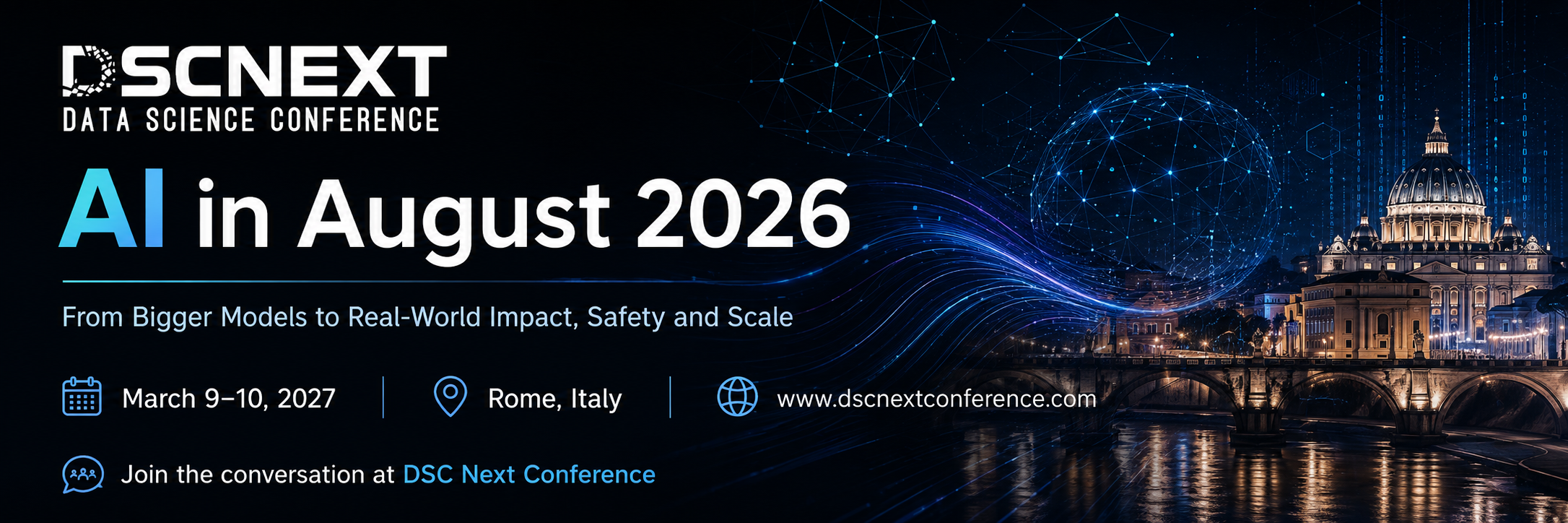
DSC Next Conference 2027 will take place:
📅 March 9-10, 2027
📍 Rome, Italy
🌐 www.dscnextconference.com
The international conference brings together researchers, academics, data scientists, AI practitioners, business leaders, technology professionals and innovators to discuss advances shaping artificial intelligence, machine learning and data science.
Agentic AI is already closely connected with the conference’s wider focus.
DSC Next covers areas including Generative AI, agentic systems, NLP and LLMs, AI ethics, machine learning, data infrastructure, cybersecurity, analytics and real-world AI implementation across industries.
The rise of systems such as ChatGPT Work, Claude Code, Claude Cowork and Claude Tag makes those discussions increasingly urgent.
By March 2027, the conversation may have moved even further.
Organizations may be managing larger numbers of autonomous agents.
More companies may be redesigning jobs around AI.
Agent security and identity could become major enterprise requirements.
Multi-agent workflows may move from experimental projects into production.
And businesses may increasingly need to answer a difficult question:
How do we use AI agents to become more productive without removing the human judgment, accountability and expertise that organizations still depend on?
DSC Next 2027 provides a platform for researchers, practitioners and industry leaders to examine these questions through technical presentations, real-world case studies, keynote sessions, panel discussions and cross-industry conversations. The conference follows the 2026 Amsterdam edition and will return for its third edition in Rome.
From AI Assistant to AI Coworker
Chatbots changed how people access information.
Generative AI changed how people create.
AI agents could change how work itself is organized.
ChatGPT Work can already remain with a project for hours.
Claude Code can execute substantial software development workflows.
Claude Cowork extends agentic execution beyond programmers.
Claude Tag allows teams to bring an AI agent directly into collaborative workspaces.
And developer platforms are making it increasingly easy for organizations to build their own specialized agents.
The technology is moving quickly.
But the future should not simply be about giving machines as much autonomy as technically possible.
The bigger challenge will be deciding where automation creates genuine value and where human judgment must remain central.
That may become one of the defining technology questions of the next decade.
And it will be one of the conversations worth continuing when the global data science community meets in Rome.
Data Science Next Conference 2027
3rd Edition, International Data Science Next Conference
March 9-10, 2027 | Rome, Italy
www.dscnextconference.com
For more information about speaking, partnerships, media opportunities or participation:
Diwakar Chandra Gour
diwakar@dscnextconference.com
The age of AI that answers questions is already giving way to the age of AI that takes action. The challenge now is making sure humans remain in control of where those actions take us.
 Reach us on WhatsApp